FIVE MATCHES, FIVE AWARDS: LIONEL MESSI’S WORLD CUP LEGACY GROWS EVEN GREATER
JUST CALL IT THE LEO MESSI AWARD:

Writing
FIVE MATCHES, FIVE AWARDS: LIONEL MESSI’S WORLD CUP LEGACY GROWS EVEN GREATER
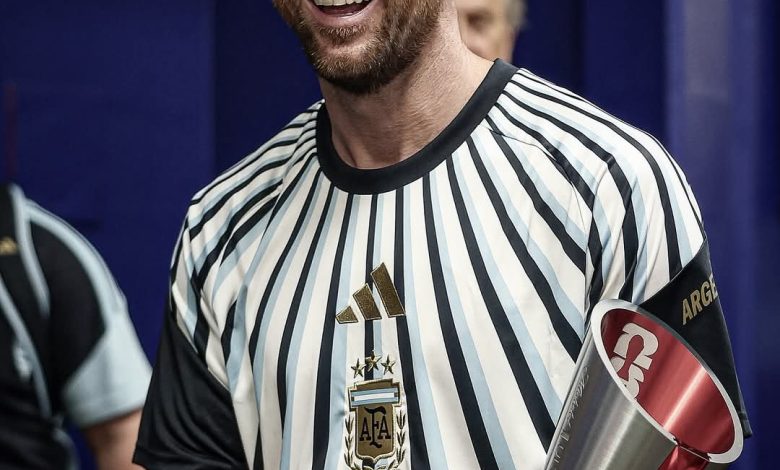
Few players in football history have managed to redefine what is possible over the course of a career. Even fewer have sustained that brilliance well into the latter stages of their playing days. Yet Lionel Messi continues to challenge every assumption about age, longevity, and excellence. At 39 years old, the Argentine captain has once again reminded the football world why he remains one of the sport’s most influential figures, collecting his fifth FIFA Man of the Match award of the 2026 FIFA World Cup.
The achievement is remarkable not simply because of the number itself, but because of the consistency it represents. Winning one Man of the Match award during a World Cup is an accomplishment. Winning two or three suggests a player is enjoying a memorable tournament. Winning five demonstrates a level of influence that few players in football history have ever reached on the game’s biggest stage.
Throughout Argentina’s journey, Messi has repeatedly stepped forward when his country needed inspiration. Whether controlling the tempo of matches, creating chances for teammates, scoring crucial goals, or producing moments of individual brilliance, he has once again shown why his name continues to define football excellence across generations.
Every World Cup introduces a new collection of stars eager to make their mark. Young talents arrive determined to announce themselves to the world, while experienced veterans fight to prove they still belong among the elite. Despite the emergence of countless gifted players, Messi has consistently remained at the center of the tournament’s biggest conversations.
His first standout performance came against Algeria during the group stage. Argentina needed leadership and composure to begin their campaign positively, and Messi delivered both. He orchestrated attacks with trademark precision, dictated possession, and demonstrated the calm decision-making that has characterized his entire career. It was the type of display that immediately reminded everyone that, regardless of age, his football intelligence remains among the finest the sport has ever witnessed.
As the tournament progressed into the knockout rounds, the pressure naturally intensified. Every mistake became more costly, every opportunity more valuable, and every performance more heavily scrutinized. Yet Messi seemed to thrive under those circumstances.
Against Cape Verde in the Round of 32, Argentina encountered determined opposition unwilling to surrender easily. Messi responded with another commanding performance, constantly finding pockets of space between defenders while creating opportunities seemingly out of nothing. His vision transformed difficult situations into dangerous attacks, allowing Argentina to maintain control during critical moments of the contest.
Receiving another FIFA Man of the Match award reflected not merely individual statistics but the broader influence he exerted over the entire match. Football is often decided by subtle details—one intelligent movement, one perfectly weighted pass, one split-second decision. Messi continues to master those moments better than almost anyone.
The Round of 16 presented another stern challenge against Egypt. Knockout football frequently rewards patience, discipline, and experience as much as technical quality. Once again, Messi embodied all three qualities.
He displayed exceptional awareness throughout the encounter, knowing exactly when to accelerate play and when to slow the tempo. His ability to read defensive structures allowed Argentina to exploit spaces that appeared invisible to everyone else on the pitch. By the final whistle, Messi had once again earned recognition as the game’s outstanding performer.
Many players rely heavily on physical speed throughout their careers. As those physical attributes gradually decline with age, maintaining elite performances becomes increasingly difficult. Messi has approached the challenge differently. Rather than depending exclusively on acceleration, he has continually evolved his understanding of positioning, timing, and decision-making.
That evolution has enabled him to remain effective against younger, faster opponents. While defenders may cover greater distances, few possess the anticipation required to consistently predict Messi’s next move. His greatest strength has never simply been pace; it has been his extraordinary football intelligence.
The quarter-final against Switzerland provided another opportunity to demonstrate precisely that quality. By this stage of the tournament, every remaining nation believed it possessed a genuine opportunity to lift football’s most prestigious trophy. Margins were exceptionally small, making leadership more important than ever.
Messi embraced the responsibility once again.
Throughout the match, he remained heavily involved in Argentina’s attacking movements, linking midfield and attack with effortless precision. His composure under pressure allowed teammates to play with greater confidence, while his creativity continually stretched the Swiss defensive structure.
Another FIFA Man of the Match award followed.
By now, discussions surrounding Messi’s tournament had shifted dramatically. No longer were analysts merely praising isolated performances; they were beginning to examine whether the tournament itself would ultimately become another defining chapter in one of football’s greatest careers.
The semi-final against England represented perhaps Argentina’s biggest challenge of the competition. England arrived with confidence, talent, and belief after an impressive tournament run. Many expected an evenly balanced contest capable of being decided by the smallest details.
Once again, those decisive moments belonged to Messi.
Whether through his movement, passing, leadership, or ability to influence key phases of play, he demonstrated why he remains capable of changing the course of the biggest matches. His performance earned widespread admiration and ultimately secured his fifth FIFA Man of the Match award of the tournament.
Five matches. Five awards.
Those numbers tell an extraordinary story.
Individual awards never define greatness entirely, but they often reflect sustained excellence over time. In Messi’s case, each recognition represents another reminder that football’s greatest stages continue to bring out his very best.
What makes this achievement even more impressive is the quality of competition. Modern international football has never been more competitive. Tactical preparation has improved dramatically, defensive organization has become increasingly sophisticated, and athletic standards continue to rise every year.
Despite those challenges, Messi continues to discover solutions others simply cannot see.
His influence extends well beyond goals and assists. Younger teammates often speak about the confidence they gain simply by sharing the pitch with him. Opponents consistently adjust their entire defensive strategy because of his presence alone. Coaches dedicate countless hours attempting to limit his influence, yet he frequently finds new ways to impact matches.
Leadership has become another defining feature of Messi’s later career. Earlier in his professional journey, he often led primarily through performances. Today, he combines those performances with visible encouragement, calm communication, and invaluable experience.
His teammates understand that every World Cup opportunity is precious. Having a captain who has experienced both triumph and disappointment provides emotional stability during the tournament’s most demanding moments.
There is also something particularly inspiring about witnessing elite longevity in professional sport. Football careers are notoriously demanding. The physical requirements increase every season, recovery becomes more challenging with age, and maintaining motivation after decades of success requires extraordinary dedication.
Messi’s continued excellence reflects countless unseen hours of preparation.
Training sessions, recovery routines, nutritional discipline, tactical study, and mental resilience all contribute to performances that appear effortless on match day. Greatness rarely arrives through talent alone. Sustaining greatness over two decades demands relentless commitment.
Football supporters across generations have now watched Messi redefine expectations multiple times.
As a teenager, he was viewed as an extraordinary prodigy.
In his twenties, he established himself among the world’s elite.
In his thirties, he captured international glory and continued breaking records.
Now, at 39, he remains one of the defining players of the world’s biggest football tournament.
Such longevity places him in exceptionally rare company.
His performances have also sparked renewed discussions about football’s greatest-ever players. Every generation produces icons capable of inspiring millions, but only a select few maintain world-class standards across such an extended period.
Messi belongs firmly within that exclusive group.
Statistics provide valuable evidence of his achievements, yet they never fully capture the emotional impact he has on supporters. Every time he receives possession, stadiums collectively anticipate something special. Fans from every corner of the world watch with heightened expectation because history has repeatedly demonstrated that extraordinary moments often follow.
That connection between player and audience represents one of sport’s most remarkable qualities.
Children imitate his style in parks and school playgrounds. Professional footballers openly acknowledge learning from his movement and creativity. Coaches analyze his positioning to educate future generations.
His influence reaches far beyond trophies and medals.
The five FIFA Man of the Match awards earned during this World Cup therefore symbolize much more than individual recognition. They illustrate consistency, adaptability, professionalism, and enduring excellence against the highest level of competition.
Every tournament introduces fresh narratives.
Some celebrate emerging stars.
Others focus on tactical innovation.
Many revolve around dramatic upsets or unforgettable goals.
Yet throughout this World Cup, one storyline has remained remarkably consistent: Lionel Messi continues to produce world-class football despite approaching four decades of life.
That reality challenges conventional thinking about sporting longevity.
Instead of gradually fading from international relevance, he continues competing directly against football’s brightest young talents—and frequently outperforming them.
Argentina’s supporters naturally hope these performances ultimately lead to another unforgettable conclusion. Regardless of the tournament’s final outcome, Messi’s contribution has already become one of its defining stories.
Future generations will examine these performances with admiration.
Analysts will revisit the tactical intelligence displayed throughout the tournament.
Supporters will remember the decisive passes, the composed finishes, the moments of inspiration, and the leadership shown under immense pressure.
Football history is filled with legendary World Cup campaigns.
Certain tournaments become permanently associated with iconic individuals whose performances transcend ordinary expectations.
Messi’s 2026 campaign now deserves consideration among those memorable individual displays.
Five FIFA Man of the Match awards stand as compelling evidence of sustained brilliance rather than isolated moments.
As the tournament reaches its conclusion, conversations surrounding Messi’s legacy will undoubtedly continue. Records may eventually be challenged, new stars will emerge, and football will continue evolving.
However, what cannot easily be replicated is the extraordinary combination of technical excellence, tactical intelligence, consistency, professionalism, humility, and longevity that Messi has demonstrated throughout his remarkable career.
At 39 years old, he continues to inspire teammates, excite supporters, and challenge opponents.
He continues to influence football’s biggest matches.
He continues to collect individual honors.
Most importantly, he continues to remind the world that true greatness is measured not simply by extraordinary peaks, but by the ability to sustain excellence year after year, tournament after tournament, and generation after generation.
Five matches.
Five FIFA Man of the Match awards.
One extraordinary footballer whose World Cup legacy has grown even greater.
For millions of supporters around the globe, there may never be another player quite like Lionel Messi. His story continues to evolve, his influence continues to expand, and every appearance adds another unforgettable chapter to one of the greatest careers the beautiful game has ever witnessed.