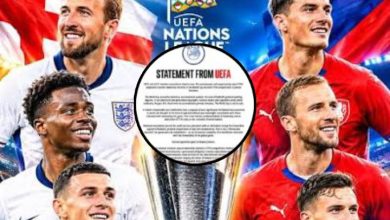
UEFA RESPONDS TO SPAIN STATEMENT AS REASON REVEALED WHY DAN BURN HANDBALL WAS NOT GIVEN AS A PENALTY
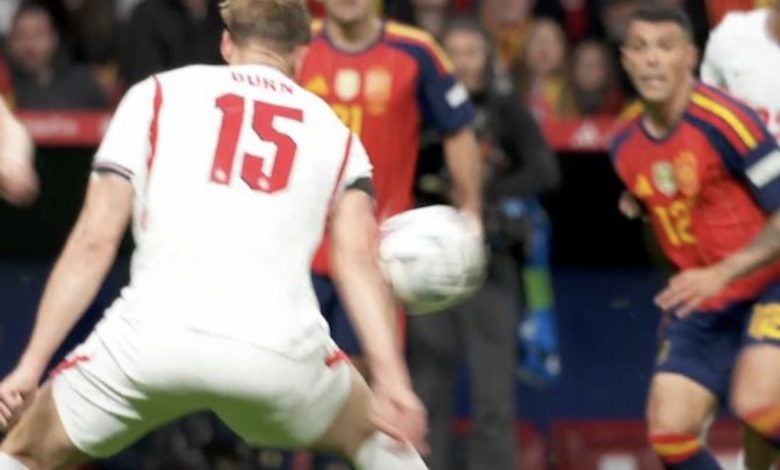
Spain were left furious in the closing stages of their UEFA Nations League clash with England after appealing for a penalty when the ball appeared to strike Dan Burn’s arm inside the penalty area.
The incident happened during the final moments of Spain’s 3–2 defeat to England in Madrid, with La Roja desperately searching for an equaliser after fighting back from 3–0 down. The ball struck Burn’s arm as Spain attempted to create another opening, immediately prompting appeals from the Spanish players for a spot-kick.
However, French referee Clément Turpin waved away the protests, while the VAR team did not recommend an on-field review. Spain were therefore denied the opportunity to take a potentially crucial penalty in stoppage time.
The decision has generated considerable debate because there was clearly contact between the ball and Burn’s arm. But contact between the ball and a hand or arm does not automatically constitute a handball offence under UEFA’s interpretation of the Laws of the Game.
WHY WASN’T IT A PENALTY?
The key issue was the position of Burn’s arm.
From the available image of the incident, Burn’s arm is positioned very close to his body rather than being deliberately extended away from his body to make himself bigger. That distinction is particularly important under UEFA’s current handball guidance.
UEFA explains that officials must consider whether the contact was deliberate and whether the defender made their body unnaturally bigger. Its guidance specifically states that VAR should recommend cancelling a penalty when a defender’s arm is positioned close to or against the body, or when the arm is clearly in a natural position for the movement involved.
That principle appears to be the strongest explanation for why Spain did not receive a penalty.
In other words, the fact that the ball touched Burn’s arm was not enough on its own. Officials had to determine whether his arm was in an unnatural position or whether he had deliberately moved it towards the ball.
The evidence visible in the incident suggests neither.
SPAIN’S ARGUMENT
From Spain’s perspective, the frustration is understandable.
The ball travelled directly towards Burn and appeared to make contact with his arm, preventing the ball from continuing in its original path. Spanish players immediately appealed, believing the contact had stopped an attacking move that could have produced a late equaliser.
Pedro Porro was among the Spain players involved in the attacking move, while other Spanish players also protested the decision. With the clock already deep into stoppage time, a penalty could have dramatically changed the final moments of the match.
Spain had already recovered from a disastrous start.
England had established a 3–0 advantage through Harry Kane, Ezri Konsa and Ben White before Elliot Anderson was sent off after conceding a penalty. Mikel Oyarzabal converted from the spot before Nico Williams pulled another goal back, leaving England under enormous pressure.
That made the late Burn incident even more significant.
UEFA’S HANDball GUIDANCE EXPLAINS THE DECISION
UEFA’s published guidance makes an important distinction between accidental contact and an arm being used to make the defender’s body bigger.
A penalty can be recommended when a defender deliberately moves their hand or arm towards the ball, holds the arm away from the body in an unnatural position, or blocks a shot while making the body unnaturally larger.
But UEFA also says VAR should recommend cancelling a penalty when the arm is close to the body or clearly in a natural position for the player’s movement.
That is particularly relevant to the Burn incident.
Although Spain wanted the contact to be punished, Burn did not appear to deliberately reach out with his hand to block the ball. His arm remained close to his body as he attempted to defend the situation.
Therefore, the crucial question was not simply “Did the ball hit his arm?”
It was “Was his arm in an unnatural position that made his body bigger?”
Based on UEFA’s published criteria, that is the reason the incident could be judged as not a penalty.
WHY THE IMAGE CAN BE MISLEADING
Still images often make handball decisions look much clearer than they actually are.
UEFA specifically warns referees that a defender’s arm can look different in a frozen image compared with what happens during the full movement. Officials are instructed to consider the player’s movement, the distance from the ball, whether the defender could avoid the contact and whether there was movement of the arm towards the ball.
That matters in Burn’s case.
From the photograph, it is easy to focus entirely on the ball touching his arm. But the referee and VAR were required to assess the entire sequence rather than one frame.
If the arm was already in a natural position close to his body and Burn did not move it towards the ball, the contact alone does not automatically turn the incident into a punishable handball.
A DECISION THAT WILL CONTINUE TO BE DEBATED
Spain can understandably feel that they were unlucky because the contact occurred during a dangerous attacking situation and came at a time when they were pushing for an equaliser.
However, UEFA’s handball guidance provides a clear framework for understanding why the referee did not award the penalty.
The decision was not based simply on whether Burn’s arm touched the ball. The decisive consideration was the position of the arm and whether he had made his body unnaturally bigger.
In this case, Burn’s arm was close to his body, which strongly supports the decision to allow play to continue.
England eventually held on for a dramatic 3–2 victory, ending Spain’s remarkable 43-match unbeaten run and securing top spot in Nations League Group A3.
The late handball controversy will undoubtedly remain part of the post-match discussion, but under UEFA’s published interpretation, not every ball-to-hand contact is a penalty — and an arm positioned close to the body is one of the clearest reasons for a referee and VAR to reject a spot-kick appeal.