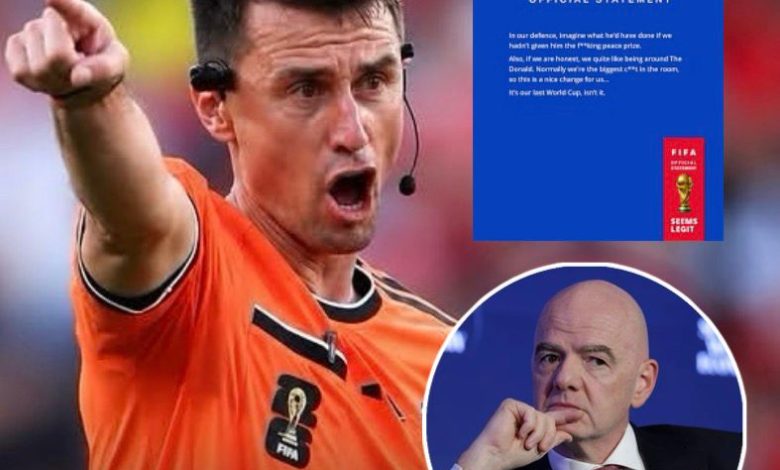
The aftermath of Scotland’s controversial FIFA World Cup defeat to Morocco has taken another dramatic turn after reports emerged that the referee who officiated the fiercely contested encounter has been removed from officiating duties for the next four FIFA World Cup matches.
While FIFA has yet to confirm that the decision is directly linked to the Scotland versus Morocco clash, the development has reignited debate surrounding several contentious moments that dominated discussions after Morocco secured a narrow 1-0 victory in the Group C fixture.
For Scotland supporters, the news has reopened painful memories of a match they believe was heavily influenced by controversial refereeing decisions. For neutral observers, it raises fresh questions about FIFA’s standards for officiating at football’s biggest tournament.
A Match Filled With Controversy
Scotland entered the encounter knowing that a positive result against Morocco would significantly strengthen their chances of progressing from one of the tournament’s toughest groups.
Having opened their campaign with an impressive victory over Haiti, Steve Clarke’s side arrived full of confidence.
Morocco, meanwhile, had already demonstrated their quality by holding Brazil to a draw and were determined to take another major step toward qualification.
From the opening whistle, the game was played at an intense tempo.
Morocco enjoyed more possession during the early stages, while Scotland relied on their organisation, disciplined defending and dangerous counter-attacks.
However, attention quickly shifted away from the football itself as several controversial refereeing decisions became the talking point.
Key Decisions Spark Debate
The first major flashpoint arrived midway through the opening half when Scotland appealed strongly for a penalty following a challenge inside Morocco’s penalty area.
Scottish players immediately surrounded the referee, believing there had been clear contact.
Despite lengthy protests, play was waved on.
The decision immediately divided pundits and supporters.
Later in the match, Scotland felt they should have been awarded several free-kicks in dangerous positions after robust Moroccan challenges went unpunished.
Tempers continued to rise as yellow cards were shown inconsistently, with both teams expressing frustration.
Perhaps the biggest controversy arrived during Morocco’s winning goal.
Several Scotland players believed there had been a foul during the build-up before the ball eventually found the back of the net.
Despite furious appeals, the goal stood.
Following the final whistle, Scottish players could be seen speaking passionately with the match officials before leaving the pitch visibly disappointed.
FIFA Removes Referee From Four Matches
Only days after the fixture, reports emerged that the referee had been withdrawn from officiating responsibilities for the next four FIFA World Cup matches.
Although FIFA regularly rotates referees throughout the tournament, the timing of the decision has inevitably attracted widespread attention.
Many supporters have interpreted the move as evidence that FIFA’s refereeing committee identified concerns with the official’s overall performance.
Others have urged caution, pointing out that appointments are based on numerous factors including performance assessments, tournament scheduling, fitness management and referee rotation policies.
As is standard practice, FIFA evaluates every official after each World Cup fixture.
Assessors review:
Decision-making accuracy
Positioning
Communication
Application of the Laws of the Game
VAR cooperation
Match control
Officials who perform strongly generally receive appointments for later knockout matches.
Those receiving lower assessments may wait longer before being selected again—or not receive another appointment during the tournament.
Scotland’s Frustration
Scotland manager Steve Clarke carefully chose his words after the defeat.
Rather than placing all blame on the referee, he acknowledged that his side also missed opportunities to influence the outcome.
However, several Scottish players were clearly disappointed with some of the decisions.
Supporters echoed those frustrations across social media.
Many argued that Scotland deserved at least one penalty.
Others questioned why certain Moroccan challenges escaped punishment.
Some even called for greater transparency regarding referee assessments after major international matches.
Whether those complaints ultimately influenced FIFA’s internal review remains unknown.
Morocco Keep Their Focus
While Scotland supporters continued debating the officiating, Morocco maintained their concentration on the tournament.
The Atlas Lions have established themselves as one of the strongest teams in world football following their historic run to the semi-finals at the previous World Cup.
Their tactical discipline, technical quality and defensive organisation once again proved decisive.
Despite the controversy, Morocco insisted that their victory resulted from strong preparation and clinical finishing.
Their players avoided becoming involved in the refereeing discussion, instead highlighting the importance of collecting three valuable points.
The Pressure On World Cup Referees
Refereeing at the FIFA World Cup remains one of football’s most demanding roles.
Officials must make split-second decisions under enormous pressure while millions watch around the globe.
Every major decision is analysed from multiple camera angles.
VAR has undoubtedly improved decision-making accuracy in recent tournaments.
However, it has also increased expectations.
Supporters now expect virtually every important decision to be correct.
When controversy arises, criticism spreads rapidly across television, newspapers and social media.
For referees, maintaining consistency throughout 90 minutes is an incredibly difficult challenge.
FIFA’s Referee Evaluation System
FIFA invests significant resources into preparing referees before every World Cup.
Officials undergo:
Extensive physical fitness testing.
Video analysis sessions.
VAR training.
Psychological preparation.
Match simulations.
Continuous performance reviews.
Every performance receives detailed analysis from experienced referee assessors.
These reports help determine future appointments.
Only the highest-performing officials are usually selected for the knockout rounds and ultimately the World Cup Final.
Being removed from several appointments does not necessarily end a referee’s international career.
Many officials have returned stronger after difficult tournaments.
What This Means For Scotland
Despite the disappointment against Morocco, Scotland’s World Cup campaign remains alive.
The focus now shifts toward responding positively in their remaining fixtures.
Steve Clarke’s squad know they cannot afford to dwell on controversial decisions.
Qualification will ultimately depend on their performances on the pitch.
The players will need to show resilience, improve their attacking efficiency and continue displaying the defensive discipline that has characterised Clarke’s team.
If Scotland can bounce back with positive results, the Morocco defeat may eventually be remembered as a learning experience rather than the defining moment of their tournament.
Fans Continue The Debate
Football supporters remain deeply divided.
Some believe the referee made several costly mistakes that affected the outcome.
Others argue that every match contains controversial moments and Scotland simply failed to convert their chances.
Regardless of opinion, one fact is clear: the referee has become one of the biggest talking points of this year’s FIFA World Cup.
Whether the reported removal from four matches is directly connected to the Scotland-Morocco encounter may never be publicly confirmed.
FIFA traditionally keeps its internal referee assessment process confidential.
That secrecy often fuels even greater speculation among fans.
Lessons For FIFA
Incidents like these continue to strengthen calls for increased transparency.
Many analysts believe FIFA should publish referee assessment summaries after major tournament matches.
Such openness could help supporters better understand difficult decisions while increasing confidence in the officiating process.
Others argue that protecting referees from excessive public scrutiny remains equally important.
Finding the right balance will remain one of football’s biggest challenges as technology continues to evolve.
Looking Ahead
Scotland’s defeat to Morocco may ultimately prove to be one of the defining moments of their World Cup campaign.
Whether remembered for Morocco’s disciplined victory or for the officiating controversy depends largely on what happens next.
If Scotland recover to reach the knockout stages, the debate may gradually fade.
If they fail to qualify, questions surrounding the referee’s performance are likely to remain part of the tournament’s lasting narrative.
Meanwhile, Morocco continue their pursuit of another memorable World Cup run, while FIFA faces renewed scrutiny over how it manages and evaluates officials on the biggest stage in world football.
Whatever the final verdict, the controversy surrounding the Scotland versus Morocco referee has become another reminder that at the FIFA World Cup, every decision matters—and every whistle can shape football history.