SCOTLAND FACE HUGE FIFA PUNISHMENT AFTER FANS DISPLAY CONTROVERSIAL “INFANTINO IS A FANNY” BANNER DURING SWITZERLAND CLASH

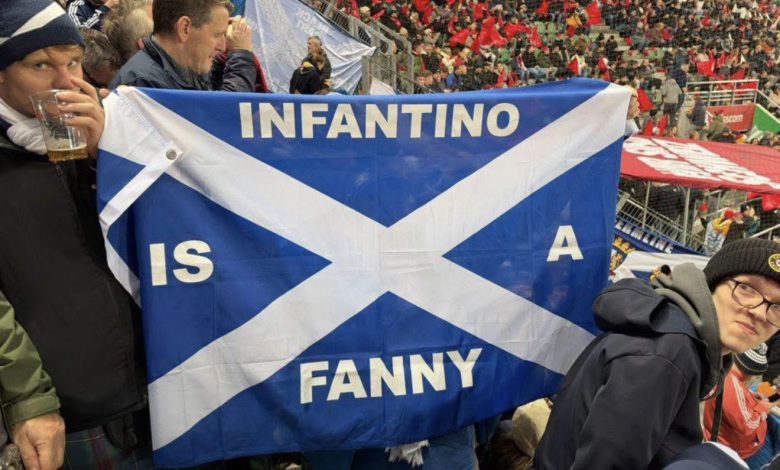
Scotland could find themselves facing a major disciplinary headache after supporters displayed a controversial banner directly targeting FIFA president Gianni Infantino during their international fixture against Switzerland.
The incident has attracted attention among football supporters, with an image showing several Scotland fans holding a large Scottish flag bearing the words: “INFANTINO IS A FANNY.”
What might have initially been considered by some supporters as another example of Scottish football humour has now raised questions about whether the incident could cross the boundaries established by football’s governing authorities.
The message was particularly noticeable because it was not directed at an opposition player, manager or referee. Instead, the supporters chose to target the man currently occupying one of the most powerful positions in world football.
Gianni Infantino has served as FIFA president since 2016, and the controversial message has inevitably generated discussion about the relationship between football supporters and the authorities responsible for governing the game.
Although supporters have traditionally used banners to express frustration, criticise decisions and make political or humorous statements, football regulations place certain restrictions on what can be displayed inside stadiums.
This is where Scotland could potentially find themselves in an uncomfortable position.
FIFA DISCIPLINARY RULES COULD BECOME A PROBLEM FOR SCOTLAND
FIFA has established disciplinary regulations that govern the behaviour of supporters and the responsibilities of national football associations during international competitions.
The FIFA Disciplinary Code contains provisions dealing with inappropriate messages and demonstrations during sporting events.
One provision worth examining is Article 13(2)(c), which concerns using a sporting event for demonstrations of a non-sporting nature.
Article 17 also deals with order and security at matches.
However, whether the banner displayed by Scotland supporters falls within these provisions would depend on FIFA’s interpretation and the circumstances surrounding the incident.
The Scottish Football Association could therefore face questions if the governing body decides to investigate the matter.
The situation is particularly interesting because the message directly mentions FIFA’s president.
It remains to be seen whether FIFA would consider the banner an ordinary expression of supporter opinion or an inappropriate demonstration under its disciplinary regulations.
WHY THE INCIDENT HAS ATTRACTED SO MUCH ATTENTION
Football supporters have never been afraid to make their opinions known.
From controversial chants to provocative banners, stadiums have frequently provided an opportunity for fans to express their feelings about football authorities.
However, the latest incident involving Scotland has attracted attention because of the identity of the person being targeted.
Infantino is not an ordinary football official. He is the president of FIFA, the organisation responsible for overseeing international football and its major competitions.
Consequently, a banner directly insulting him is likely to generate a different level of discussion compared with an ordinary disagreement involving a referee or opposing manager.
Some supporters may see the message as harmless football humour, while others could argue that there should be limits to what fans are permitted to display during international fixtures.
That disagreement could become even bigger if FIFA decides to take disciplinary action.
THE SCOTTISH FA COULD BE ASKED TO EXPLAIN THE INCIDENT
If FIFA considers the incident serious enough to warrant investigation, the Scottish Football Association could be required to respond to questions about the banner and the circumstances in which it was displayed.
Football associations are responsible for ensuring that their supporters comply with applicable competition regulations.
Previous disciplinary cases involving supporter behaviour have demonstrated that national associations can face financial penalties and other sporting sanctions when their supporters are found to have breached FIFA regulations.
FIFA does not automatically punish an entire national association every time an offensive banner appears in a stadium. The circumstances, applicable rules and available evidence all matter.
Nevertheless, Scotland could face an uncomfortable disciplinary process if the incident is formally referred to the relevant authorities.
THE POTENTIAL PUNISHMENT THAT COULD LEAVE SCOTLAND FANS FUMING
The biggest concern surrounding the reported punishment is its potential impact on Scotland’s next international fixture.
Rather than simply imposing a financial penalty on the Scottish FA, the sanction being discussed would directly affect the supporters who normally travel to follow the national team.
The reported punishment is a stadium attendance restriction that would prevent Scotland supporters from entering the stadium for their next match.
If such a sanction were officially imposed, it would represent a significant disappointment for the famous Tartan Army.
Scotland supporters are renowned for travelling in large numbers to international fixtures, creating an atmosphere that has become an important part of the national team’s identity.
Imagine Scotland preparing for their next international fixture without the familiar travelling support behind them.
The players would still have their coaching staff, national colours and supporters watching from elsewhere, but the atmosphere inside the stadium would be dramatically different.
It would also create frustration among supporters who may have had absolutely nothing to do with producing or displaying the controversial banner.
However, it is important to stress that no verified FIFA announcement has confirmed this particular stadium ban. It should therefore be treated as a possible or reported sanction, not an established punishment.
COULD FIFA’S DECISION CREATE A BIGGER DEBATE?
The situation could easily develop into a wider debate about freedom of expression in football stadiums.
Supporters will inevitably have different opinions about whether the banner crossed a line.
Some will argue that football fans should be allowed to criticise powerful figures in the game, including FIFA’s president.
Others will insist that supporters must respect the regulations governing international football and understand that certain displays could expose their national association to disciplinary consequences.
There is also the question of proportionality.
Should an entire group of travelling supporters lose the opportunity to attend a match because of a banner displayed by a small number of individuals?
That is the question Scotland supporters would likely ask if a stadium attendance restriction became official.
For now, the controversial image has provided another talking point involving football supporters and the authorities.
WHAT HAPPENS NEXT FOR SCOTLAND?
The Scottish FA could find itself under pressure to clarify whether FIFA has contacted the association about the incident.
If a formal disciplinary investigation takes place, the relevant authorities would have to establish whether the banner breached any applicable regulations before deciding whether a sanction was justified.
Until then, Scotland supporters will be waiting to see whether the controversy develops into something more serious.
One thing is certain: the banner reading “INFANTINO IS A FANNY” has attracted attention far beyond the stadium in Switzerland.
And if FIFA decides that disciplinary action is necessary, the consequences could become a major talking point throughout Scottish football.
Do you think FIFA should punish Scotland over the controversial banner, or should supporters be allowed to express their opinions about Gianni Infantino?
