SPFL FINALLY MAKES HUGE CALL ON CELTIC AFTER FANS BOOED AND JOHN BEATON ENDED SILENCE AFTER JUST 13 SECONDS

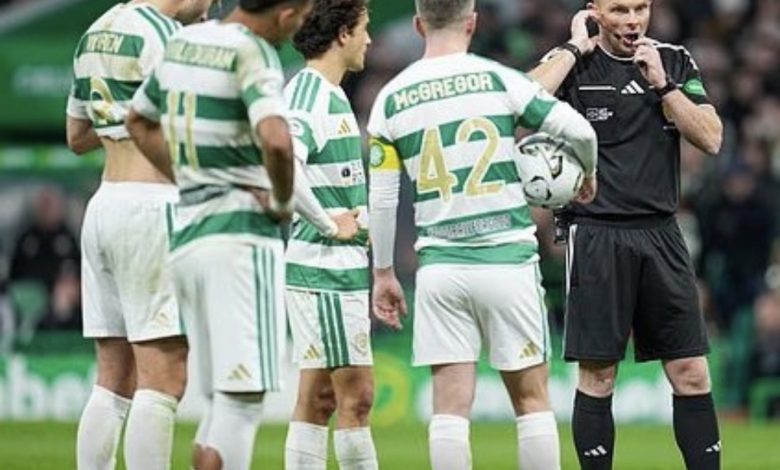
What was supposed to be a solemn moment before Celtic’s Scottish Premiership meeting with Kilmarnock quickly turned into one of the most controversial pre-match incidents of the season.
And now, after the scenes at Celtic Park attracted widespread criticism, questions have been raised over whether Celtic themselves could face consequences for what happened.
The incident occurred before the match on Remembrance Sunday, when players from Celtic and Kilmarnock gathered around the centre circle for a planned period of silence.
Referee John Beaton was responsible for starting the tribute.
However, within seconds, sections of the Celtic support began booing and jeering.
The noise became increasingly difficult to ignore.
Then came the moment that has dominated the conversation ever since.
Beaton ended the silence after approximately 13 seconds.
A tribute that was expected to last around a minute had barely begun before it was brought to an abrupt conclusion.
And that immediately raised the question:
WHO, IF ANYONE, WAS GOING TO BE PUNISHED?
CELTIC FANS’ BOOING CREATES ANOTHER MAJOR CONTROVERSY
The scenes were particularly controversial because this was not the first time a Remembrance tribute involving Celtic supporters had been disrupted.
Reports noted that similar controversy occurred during the previous season, when a Remembrance Sunday silence involving Celtic was also interrupted by sections of supporters.
There is a long-standing divide surrounding Remembrance events at Celtic.
Some supporters have historically objected to participating in the tradition because of the complicated relationship between sections of Celtic’s support, British military history and the club’s Irish heritage.
That context, however, did not prevent the latest incident from generating widespread criticism.
According to reports, the Green Brigade themselves were not occupying their usual section when the silence took place, choosing instead to remain on the concourse until the tribute had finished.
That detail has become an important part of the debate because it means the disruption did not simply involve one organised supporter group.
Instead, the booing came from sections of the wider crowd.
And once the noise began, Beaton decided that the silence could no longer continue.
THE 13-SECOND MOMENT THAT EVERYONE IS TALKING ABOUT
The referee’s decision to end the tribute after just 13 seconds has become the defining image of the controversy.
Players were standing together in the centre circle.
Officials were positioned around them.
The stadium had been expected to observe the occasion.
But instead, loud reactions from sections of the crowd changed the entire atmosphere.
The whistle eventually sounded again.
The silence was over.
Just 13 seconds.
That number has since become central to the argument, with supporters, pundits and observers debating whether Beaton should have allowed the tribute to continue despite the disruption.
Some argue that ending it early simply allowed the supporters making the noise to determine what happened.
Others believe the referee had little choice because the purpose of a silence is defeated when the stadium is filled with loud booing and jeering.
Either way, the decision created an uncomfortable situation for Scottish football.
SO WHAT DID THE SPFL ACTUALLY DECIDE?
This is where the story becomes particularly interesting.
Despite social-media claims suggesting that Celtic were about to receive a major punishment, there is currently no confirmed evidence of a huge SPFL sanction specifically for this incident.
Former Aberdeen chief executive Keith Wyness suggested that Celtic were unlikely to face a formal sporting punishment, although he said a warning or letter from the Scottish FA could be possible.
That distinction matters.
The SPFL has disciplinary powers when clubs breach its rules concerning unacceptable conduct, and it has previously imposed fines, suspended stadium restrictions and other sanctions for incidents involving supporters.
But those published disciplinary outcomes have generally involved conduct such as pitch incursions and dangerous or orchestrated pyrotechnic use.
The Remembrance silence incident presents a much more complicated situation.
There was no pitch invasion.
There was no reported attack on a player.
There was no pyrotechnic incident.
Instead, the controversy centres on supporters booing and jeering during a pre-match tribute and the referee deciding to terminate the silence.
That makes the question of punishment considerably less straightforward.
CELTIC NOW FIND THEMSELVES UNDER THE SPOTLIGHT
Even without a major financial penalty or stadium closure, the incident has once again placed Celtic at the centre of a national debate.
The club has already dealt with numerous controversies involving supporter behaviour and the relationship between sections of its fanbase and football authorities.
This latest incident has added another chapter.
There is also an uncomfortable question for Celtic’s hierarchy.
What can the club realistically do when supporters inside the stadium decide not to participate in a tribute?
Celtic cannot control every individual supporter.
At the same time, clubs have responsibilities concerning conduct inside their stadiums.
That is why the authorities could still examine whether the club took all reasonable steps to deal with the situation.
The SPFL’s rules specifically recognise that stadium operations can involve police match commanders and other public authorities, meaning responsibility is not always as simple as blaming the home club for everything that happens in the stands.
KILMARNOCK WERE ALSO CAUGHT IN THE MIDDLE
For Kilmarnock, the controversy was particularly uncomfortable.
Their players were also present for the tribute.
They had travelled to Celtic Park expecting to play a Scottish Premiership match, but their players became part of a political and cultural argument that has followed Celtic for years.
The incident therefore went beyond Celtic supporters.
It became another debate about football, remembrance, history and whether players and opposing supporters should be allowed to observe a moment of respect without disruption.
And that is precisely why the authorities’ response matters.
THE BIG QUESTION IS NOW HANGING OVER SCOTTISH FOOTBALL
The most explosive part of the story is not necessarily what has already happened.
It is what could happen next.
Will the authorities simply move on?
Will Celtic receive an official warning?
Could the incident be reviewed under the SPFL’s rules?
Or will the governing bodies decide that there is no disciplinary offence that warrants punishment?
At the moment, reports do not support claims that Celtic have been handed a huge punishment.
But that has not stopped supporters on both sides from demanding action.
For Celtic fans, the argument will be about freedom of expression and the club’s complicated historical relationship with Remembrance events.
For critics, the issue is much simpler.
They believe a minute of silence should be respected regardless of personal or political views.
And somewhere in the middle of that argument stands John Beaton, who found himself forced to make an extraordinary decision before a football had even been kicked.
A silence intended to last around a minute lasted just 13 seconds.
Now everyone wants to know whether those 13 seconds will lead to consequences for Celtic.