VERBAL ABUSE OF LAWRENCE SHANKLAND BY CELTIC FANS SPARKS OUTRAGE AFTER SCOTLAND GOAL VS BOLIVIA

A moment of national celebration overshadowed by controversy
Scotland’s recent international friendly victory over Bolivia was supposed to be a straightforward, morale-boosting performance ahead of a busy competitive period. The match itself delivered exactly that on the pitch: goals, attacking fluency, and another reminder of Scotland’s improving forward options.
Among the scorers was Hearts striker Lawrence Shankland, who once again demonstrated his importance to the national team setup with a well-taken finish that contributed to Scotland’s dominant win.
However, what should have been a routine celebration of international football has instead become the centre of controversy after reports and footage emerged showing a section of fans—identified in multiple reports as Celtic supporters—verbally abusing the striker during and after the match.
The incident has reignited long-standing debates in Scottish football about club rivalry, fan behaviour, and the toxic overlap between domestic loyalties and international duty.
What happened during the match?
The Scotland vs Bolivia fixture was played in front of a lively crowd, with expectations of a comfortable Scottish victory. Steve Clarke’s side delivered, controlling the game and scoring freely.
Lawrence Shankland’s goal was one of the highlights. The striker’s movement inside the box and clinical finish reflected why he continues to be selected at international level despite intense competition for attacking places.
But attention quickly shifted away from football when sections of the crowd were seen directing verbal abuse towards the striker following his goal.
According to widely circulated footage and reports, some individuals in Celtic colours were visibly shouting and gesturing toward Shankland during celebrations.
While the exact content of the abuse has not been formally detailed in official statements, the behaviour has been described by witnesses and online discussion as “hostile”, “aggressive”, and “targeted”.
The situation escalated further on social media after clips spread showing the reaction in the stands.
The viral image and fan identification claims
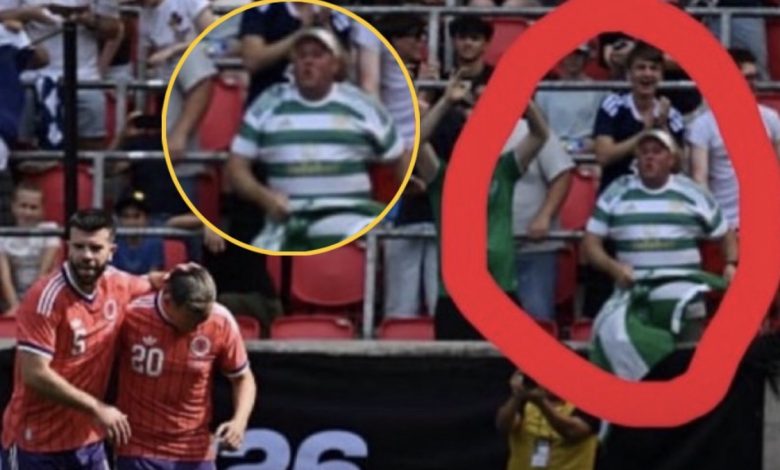
The image you shared shows two individuals in Celtic-style green and white hoops, highlighted by circles, which has been widely circulated online alongside claims that they were involved in verbally abusing Shankland during the match.
While images like this often fuel immediate outrage, it is important to note that visual identification alone does not confirm specific actions. However, in this case, the image has become symbolic of a wider debate already brewing within Scottish football culture.
Social media platforms quickly amplified the clip, with fans divided between:
- Those condemning the behaviour as unacceptable abuse of a Scotland player
- Those arguing it was exaggerated or misinterpreted
- Others pointing to long-standing club rivalry tensions spilling into international fixtures
This division is not new in Scottish football, but the visibility of modern broadcasting and online platforms has intensified it significantly.
The Shankland factor: why he is a focal point
Lawrence Shankland is one of Scotland’s most consistent attacking players, having established himself through strong performances at club level and a growing role in the national team.
However, he is also a figure who divides opinion in some fan circles due to:
- His association with Hearts, a direct rival to Celtic and Rangers in different contexts
- Past transfer speculation involving major Scottish clubs
- His playing style, which some fans view as traditional rather than flashy
- General rivalry-driven bias in Scottish football culture
In international football, players are usually expected to be united under one national identity. But Scotland’s football environment is unique in that club loyalties—particularly Old Firm affiliations—often influence perception even at national team level.
Shankland becoming a target for verbal abuse after scoring for Scotland reflects that ongoing tension.
Fan behaviour and where the line is crossed
Football crowds are emotional environments. Shouting, chanting, and passionate reactions are part of the sport’s culture. However, there is a clear distinction between:
- Competitive support
- Criticism of performance
- Personal abuse directed at players
In this case, reports suggest the behaviour crossed into the latter category.
Verbal abuse directed at a player representing his country raises questions about professionalism and respect within the fanbase. Many analysts argue that regardless of club allegiance, Scotland’s national team should be a unifying force.
The issue becomes even more sensitive when the target is a player who has directly contributed to a win.
Social media reaction: split opinion and escalating tensions
As soon as footage emerged online, debate intensified rapidly.
A large portion of fans condemned the behaviour outright, arguing that:
- No player representing Scotland should be targeted
- Club rivalry should not enter international matches
- Abuse undermines the reputation of Scottish football
Others took a more dismissive approach, suggesting:
- The incident may have been exaggerated
- It was “banter” rather than serious abuse
- The focus should remain on the match itself
However, a significant group also pointed out that modern football environments are increasingly toxic, where players are routinely subjected to abuse both inside stadiums and online.
Shankland, as a high-profile striker, has previously experienced scrutiny, but this incident has brought renewed attention to how quickly admiration can turn into hostility.
Broader context: Scottish football’s rivalry problem
The situation cannot be understood without acknowledging the deep-rooted rivalry culture in Scottish football.
Celtic vs Rangers dominates the domestic landscape, but its influence extends far beyond those two clubs. Players from other teams often find themselves judged through the lens of:
- Allegiance
- Transfer history
- Past performances against rival clubs
Even when representing Scotland, those divisions sometimes remain visible in fan behaviour.
This is not the first time Scotland internationals have been subjected to club-influenced criticism. But incidents like this highlight how difficult it remains to fully separate national identity from domestic rivalry.
Governing bodies and potential response
While no official disciplinary action has been confirmed in relation to the Bolivia match incident specifically, football authorities have increasingly taken a stricter stance on:
- Pitch behaviour
- Abuse toward players
- Stadium security incidents
- Online harassment linked to match events
If further evidence confirms targeted verbal abuse, governing bodies could review:
- Stadium conduct regulations
- Club supporter group monitoring
- Matchday security measures
However, enforcing behaviour in international fixtures is often more complex than domestic league matches due to the mixed nature of crowds.
Impact on Shankland and Scotland setup
For Lawrence Shankland, the incident is unlikely to affect his standing in the Scotland squad directly. His performance levels remain strong, and he continues to be a reliable attacking option.
However, psychologically, repeated negative attention from sections of fans can:
- Increase pressure during international matches
- Affect player-fan relationships
- Create unnecessary distractions around performance analysis
From a team perspective, Scotland’s management will likely aim to shield players from external controversy and keep focus on upcoming fixtures.
Conclusion: a familiar but uncomfortable pattern
The alleged verbal abuse directed at Lawrence Shankland after scoring for Scotland against Bolivia is part of a wider issue in football: the erosion of respect boundaries between club rivalry and national representation.
While passion is an essential part of the sport, incidents like this highlight how easily it can spill into negativity. Whether viewed as isolated behaviour or part of a broader trend, it has once again sparked debate about what is acceptable in modern football culture.
For Scotland, the priority will remain on the pitch. But off it, questions about fan behaviour, identity, and respect continue to follow the game.
If nothing else, the Shankland incident serves as a reminder that in football, even moments of celebration can quickly become flashpoints when rivalry overshadows unity