JARROD BOWEN REVEALS THE REASON WHY HE SAYS GOODBYE TO WEST HAM FANS,HE’S CAUSED A MELTDOWN
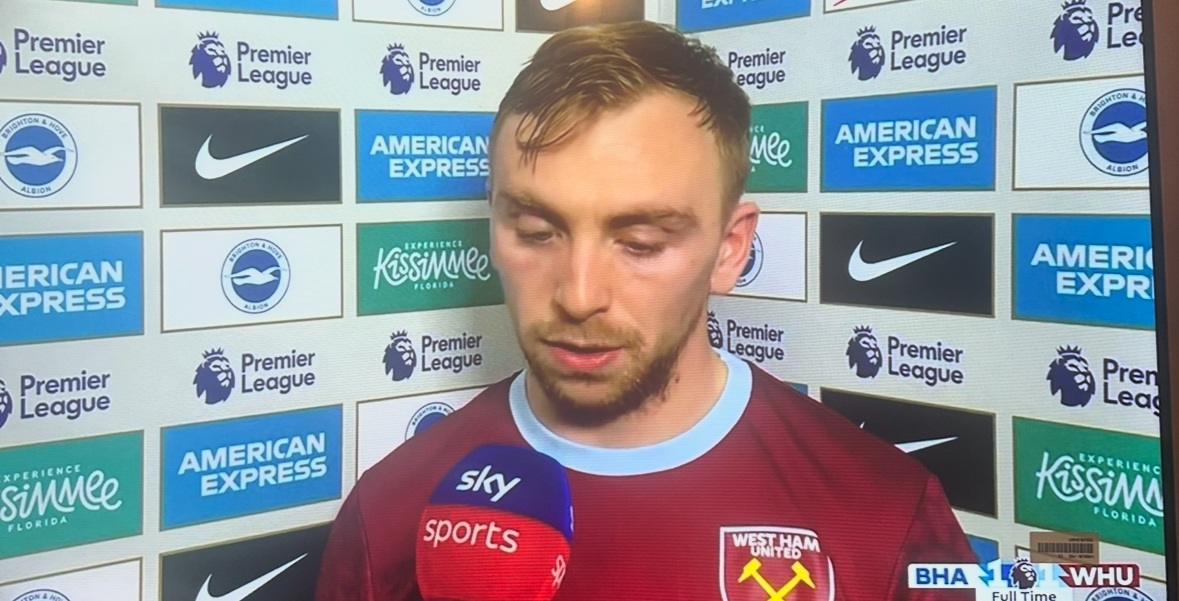
When Jarrod Bowen slid home what looked like the winner at the Amex on Sunday, it felt for a few breathless minutes like the kind of moment that can steady a season. Instead, a stoppage-time equaliser from Georginio Rutter robbed West Ham of three points and — in the chaotic aftermath — a short, emotional exchange from Bowen has set social media alight. Fans are calling it a meltdown; pundits are searching for context; and the club’s fragile form has only intensified the reaction.
Below I unpack what happened on the pitch, what we know about Bowen’s post-match behaviour, why supporters reacted so strongly, and what this could mean for the player and the club moving forward.
The match in one paragraph
Brighton and Hove Albion’s late leveller left the scoreboard at 1–1 after Jarrod Bowen opened the scoring in the 73rd minute. The visitors — battling a difficult run of form — nearly held on, only for Rutter to force the drama and VAR to confirm the equaliser in stoppage time. The draw left West Ham staring at real relegation pressure and left supporters raw and emotional.
What happened after the final whistle
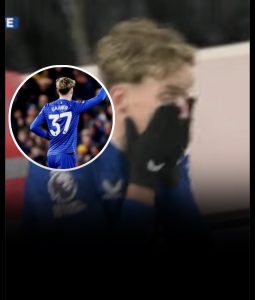
Eyewitnesses and clips circulating on social platforms showed Bowen visibly frustrated at full time. In the scramble of players and staff separating, Bowen’s body language — a mix of anger and exhaustion — was read by some viewers as a farewell gesture toward fans. That interpretation was fuelled by fans already on edge over the club’s results and by Bowen’s history of fiery post-match reactions. Because the exchange was brief and not accompanied by a clear message, it immediately divided opinion online: some called it a raw, human reaction from a player under pressure; others treated it as evidence of surrender or resignation.
Why fans reacted so strongly — the immediate context
You cannot look at this moment in isolation. Bowen is not just any player at West Ham; he’s one of the team’s most important contributors in recent years and the man who has often carried the side through difficult spells. That status amplifies everything he does. When results have been poor, his gestures — even the ambiguous ones — become symbols. On social media, fans parsed his walk off the pitch, his interaction with staff and stewards, and replayed older incidents for context. A summer (and season) full of transfer rumours, tactical upheaval, and managerial turbulence makes every emotional moment feel like a headline.
Bowen’s track record with fans — history that matters
This isn’t Bowen’s first high-profile, heated interaction involving supporters. Earlier in the campaign he was involved in a confrontation with travelling West Ham fans after a painful Carabao Cup exit; he publicly apologised afterwards and explained that frustration had boiled over. Those episodes are now being dredged up by fans and commentators debating whether what they saw at Brighton was an apology, an ultimatum, or nothing more than a player showing his human side after a crushing end to a match. That backstory helps explain why the “goodbye” interpretation spread so fast.
The psychology of an emotional captain/leader
Top-level athletes operate on an emotional knife-edge. A striker who carries the hopes of a fanbase will sometimes react with visible passion — which can be galvanising one week and explosive the next. Bowen’s body language after the draw reads like someone who feels both personally responsible and exhausted by external pressure. Fans often expect humility or ritualised thanks, not an off-the-cuff emotional moment — and the breach of that expectation is what feeds the meltdown narrative. The more invested a fanbase felt in Bowen’s heroics (he’s been the club’s talisman in recent seasons), the more any negative signal is magnified.
Media and social media: how stories get worse before they get better
A short clip, a snappy headline, and a handful of outraged posts can create the impression of a seismic event where a more measured view would see exhaustion and frustration. British tabloids and partisan fans are quick to frame ambiguous moments as either betrayal or inspiration. Right now, the dominant narrative trending online is the more sensational one: that Bowen has “said goodbye” or is at odds with supporters. But the truth is murkier — there is no official club statement saying Bowen is leaving or that he meant to quit, and Bowen has a track record of clarifying or apologising after emotional incidents.
What Bowen stands to lose — and what he can still control
If the headlines morph into transfer speculation and left unchecked, Bowen risks being dragged into months of distracting narrative. That can hurt a player’s focus and value. But he also holds agency: a clear, well-timed interview, a thoughtful social media post or, most effectively, sustained professional performance on the pitch will reshape perceptions far faster than endless speculation. Fans tend to forgive if a player shows commitment and quality; they are less forgiving when they sense arrogance or withdrawal. Bowen’s next public steps matter.
What this means for West Ham
From the club’s perspective, this is another headache on top of a results crisis. West Ham’s hierarchy will want to manage the optics: protect a star asset, reassure the fanbase, and stabilise the dressing room. Whether they do that through an internal statement, a stern word in the dressing room, or by letting on-field form do the talking, the priority will be to re-establish calm. For supporters, the moment speaks to a broader anxiety — not just about one player but about direction, ambition and accountability.
What fans should (and shouldn’t) do next
Fans naturally look for a narrative to explain pain. But the smarter response is patience and a demand for clarity rather than fomenting division. If Bowen made an impulsive gesture or emotional remark, the healthiest course is to wait for his side of the story — he has apologised before when regret followed impulse — and judge by actions, not by one ambiguous clip. Clubs win back trust through transparency, and players do the same through consistent performances and measured communication.
Final take: a human moment in a pressure cooker
Football thrives on stories. Sometimes those stories are built on facts; sometimes they’re built on feelings. The Brighton draw was brutal for West Ham; Jarrod Bowen’s visible anguish was raw and therefore headline-worthy. But until Bowen himself clarifies his words and intent, it’s worth remembering what we already know about elite athletes: a single emotional moment doesn’t define a career. It is, however, a chance for the club, the player, and the supporters to step back, speak plainly, and — crucially — demand better performances that settle argument with goals, not social feeds.



Post Comment